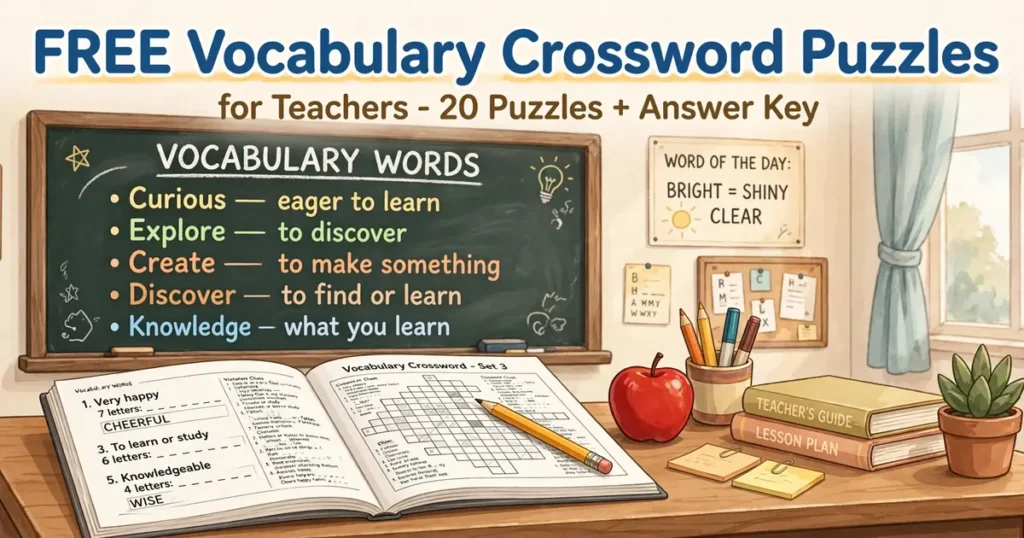
Free Printable Vocabulary Crossword Puzzles for Teachers (20 Puzzles)
If you are a teacher hunting for a vocabulary activity that actually works — one that students enjoy, that builds real academic language, and that does not eat up your entire prep period — you have found it. This free printable vocabulary crossword book for teachers gives you 20 ready-to-print crossword puzzles built around the academic words students meet across every subject: analyze, evidence, inference, summarize, thesis, fraction, hypothesis, and dozens more. Every puzzle comes with definition clues (not trivia), and a complete answer key sits at the back of the book so checking work takes seconds.
Vocabulary is the quiet engine behind reading comprehension, writing quality, and test scores. Yet finding the time to teach it explicitly — on top of everything else — is one of the hardest parts of the job. These free printable vocabulary crosswords for teachers turn that challenge into a five-minute print job: hand them out as bell-ringers, literacy centers, homework, sub plans, or early-finisher work, and your students build academic vocabulary while genuinely having fun.
Everything in this post is classroom-ready and completely free: no sign-up, no email, no cost. Just print and teach.
What Is Inside This Free Vocabulary Crossword Book?
This is a complete 20-puzzle printable book designed specifically for classroom use. Here is exactly what you get:
- 20 vocabulary crossword puzzles, one per page, each featuring around 10 academic words with clear definition clues.
- Real academic vocabulary — not random words, but the cross-curricular terms students need: ELA words (theme, metaphor, thesis), writing words (revise, cite, draft), math words (fraction, variable, perimeter), science words (hypothesis, energy, gravity), and social studies words (culture, government, continent).
- Definition-based clues that reinforce meaning every time a student reads them — solving the puzzle is itself a vocabulary lesson.
- A complete answer key with every puzzle solved, so you can check a whole class set in minutes or let students self-check at a center.
- Clean, print-friendly pages sized for US Letter paper, black-and-white friendly, so they run beautifully on any school copier.
The puzzles vary in difficulty across the book, so the same resource works for upper elementary, middle school, and even high school support classes. Because each puzzle stands alone, you can assign them in any order — match a puzzle to the week, not the other way around.
Why Crosswords Are Such a Powerful Vocabulary Tool
Teachers have used crosswords for decades, and for good reason: they hit vocabulary from multiple angles at once. When a student solves one of these vocabulary crossword puzzles, here is the learning actually happening:
Retrieval practice, not just recognition
Most vocabulary worksheets ask students to match or circle — recognition tasks. A crossword demands retrieval: the student reads a definition, searches memory for the word, and then must spell it correctly to make the crossing letters work. That extra effort is exactly what moves a word from short-term exposure into long-term memory.
Spelling gets built in automatically
Because crossing words share letters, a misspelled answer breaks the grid — students get instant, self-correcting feedback on spelling without you saying a word. For words like punctuation, hypothesis, and government, that built-in spell check is gold.
Definitions are read repeatedly
To solve a crossword, students re-read clues several times, compare them, and hold meanings in working memory. Every re-read is another meaningful encounter with the word — far more powerful than copying a definition once into a notebook.
Academic language becomes familiar, not frightening
Words like synthesize, infer, and variable intimidate students precisely because they rarely see them outside tests. Meeting these words in a low-stakes puzzle, week after week, builds familiarity — and familiarity is the first step to ownership.
The Academic Words Your Students Will Practice
The 20 puzzles in this book draw from a bank of over 50 academic vocabulary words spanning every core subject. Here is a taste of what is covered:
- Reading and ELA: theme, plot, character, setting, conflict, metaphor, simile, stanza, inference, context
- Writing: thesis, draft, revise, edit, cite, quote, summarize, paragraph, essay, grammar
- Math: equation, fraction, decimal, percent, geometry, perimeter, variable
- Science: hypothesis, experiment, energy, gravity, observe, classify
- Social studies: culture, government, continent, citizen, community
- Thinking skills: analyze, predict, conclude, persuade, define, explain
These are the words that show up in standards, on state tests, and in the directions of assignments themselves (“cite evidence,” “summarize the paragraph,” “analyze the graph”). When students own these words, every subject gets easier.
Classroom-Tested Ways to Use These Crossword Puzzles
One printable, dozens of uses. Here are the most popular ways teachers put these vocabulary crosswords to work:
1. Bell-ringers and warm-ups
Project nothing, explain nothing — just have a crossword waiting on desks when students walk in. Five to eight minutes of focused puzzle time settles a class and primes academic thinking before the lesson starts. Collect them as a participation check or let students keep a running folder.
2. Literacy and word-work centers
Place the book (or a few printed puzzles) at a center with the answer key in a sealed envelope. Students solve, then self-check. It is a genuinely independent station that needs zero teacher supervision once the routine is set — perfect for guided-reading rotations.
3. Emergency sub plans
Every teacher needs a drawer of sub-proof activities. A vocabulary crossword needs no explanation, no technology, and no expertise to supervise — a substitute can run it cold, and students still get meaningful practice. Print the whole book once and keep it in your sub tub all year.
4. Homework that students actually do
Unlike a worksheet of definitions to copy, a crossword feels like a challenge rather than a chore. Assign one puzzle a week as vocabulary homework; the built-in answer key lets families help without knowing the content.
5. Early finisher work
Keep a “puzzle parking lot” — a folder of crosswords for students who finish early. It is quiet, self-directed, and academically honest, unlike the usual busywork. Fast finishers stay engaged instead of distracting everyone else.
6. Test prep without the groans
Before a unit test, swap one review worksheet for a crossword covering the unit’s key terms. Students review definitions voluntarily because the format feels like a game — and you get a quick formative snapshot of who knows what.
7. ELL and intervention support
For English learners and struggling readers, crosswords pair the word with its meaning repeatedly in a low-pressure format. Work through the first puzzle together as a class to model the strategy, then release students to try one independently.
8. Indoor recess and rainy days
When the class is stuck inside, a stack of crosswords beats chaos. They are calm, quiet, and screen-free — and students will ask for them again.
Differentiation: One Book, Every Learner
Because the book contains 20 distinct puzzles of varying difficulty, differentiation is built in:
- Struggling students: start them on puzzles with shorter, more familiar words. Let them work with a partner or keep a word bank handy — solving with support still builds vocabulary.
- On-level students: assign puzzles straight through. Encourage them to cover the word bank (if you provide one) and rely on the clues alone.
- Advanced students: challenge them to finish against the clock, or — even better — to write their own clues for the answers after solving. Creating clues is a higher-order task that deepens mastery.
- Small groups: project one puzzle and solve it together, thinking aloud through the clues. Your think-aloud models exactly how strong readers attack unfamiliar academic words.
Tips for Printing and Classroom Management
- Print double-sided to halve your paper use — the puzzles read perfectly on the back of another page.
- Print the answer key separately and keep it at your desk or in a “check yourself” station envelope so students can self-assess without the answers circulating.
- Laminate a class set of your three favorite puzzles and use dry-erase markers for a reusable center that lasts all year.
- Build a word wall from solved puzzles: each week, add the trickiest words to the wall with student-written definitions.
- Track completion, not perfection: grade crosswords for effort and completion to keep them low-stakes. The learning happens in the solving, not the score.
Turn Solved Puzzles Into Lasting Vocabulary Gains
The crossword itself is powerful, but a two-minute follow-up locks the learning in. After students finish a puzzle, try one of these quick extension moves:
- Sentence sprint: each student picks three solved words and writes one original sentence per word. Collect the best sentences for a class slideshow.
- Word maps: students choose the hardest word from the puzzle and map it — definition, synonyms, antonyms, a sketch, and the word used in a new sentence.
- Peer teaching: partners quiz each other on the puzzle’s words without looking at the clues. Explaining a definition aloud is one of the strongest memory consolidators there is.
- Exit tickets: end class by asking every student to write one new word they learned and use it correctly in a sentence about the day’s lesson.
These tiny routines take almost no prep and transform a single puzzle page into a full vocabulary lesson cycle: encounter, retrieve, apply, and review.
More Free Printables for Your Classroom
Vocabulary is just the start. If your students love puzzle-based learning, explore more of our free printable library — every book is free, classroom-ready, and comes with answers:
- Pair these crosswords with our Free Printable Thanksgiving Mazes for Kids for a calm, seasonal early-finisher activity.
- Our Free Printable Christmas Mazes for Kids make a perfect December companion to your vocabulary routine.
- For Halloween season, try the Free Halloween Mazes for Kids — 20 puzzles with a full answer key, just like this book.
New free puzzle books are added regularly, so check back often — and if there is a topic your classroom needs, these crosswords prove that puzzle-based vocabulary practice is always in season.
Frequently Asked Questions
Are these vocabulary crosswords really free for teachers?
Yes, completely free. The full 20-puzzle book is a free PDF download with no sign-up, no email required, and no hidden cost. You may print as many copies as you need for your classroom, homeschool co-op, or tutoring sessions.
What grade levels are these puzzles for?
The puzzles are designed for upper elementary through high school. The academic vocabulary — words like analyze, evidence, thesis, and hypothesis — suits grades 4-12, and the 20 puzzles vary in difficulty so you can match them to your students.
Is an answer key included?
Yes. Every one of the 20 crossword puzzles has a complete solved answer key at the back of the book, so you can check a full class set in minutes or let students self-check at a center.
Can I use these crosswords for sub plans?
Absolutely. Vocabulary crosswords are ideal sub plans: they need no explanation, no technology, and no content expertise to supervise. Print the book once and keep it in your emergency sub tub all year.
How do I print the crossword book?
Click the download button below to get the free PDF, then print at 100% scale on US Letter paper. The pages are black-and-white friendly for school copiers. For a reusable center, laminate a class set and use dry-erase markers.
Do the clues teach vocabulary or just test it?
They teach it. Every clue is a definition, so students encounter each word’s meaning repeatedly while solving. That repeated, meaningful exposure is what moves academic vocabulary into long-term memory.
Download Your Free Vocabulary Crossword Book
Ready to make vocabulary the easiest part of your week? This free printable vocabulary crossword book gives you 20 classroom-ready puzzles with definition clues and a complete answer key — perfect for bell-ringers, centers, sub plans, homework, and test prep.
Click the big download button below to get your free PDF instantly. Print one puzzle or the whole book, and watch your students build the academic vocabulary that powers every subject.