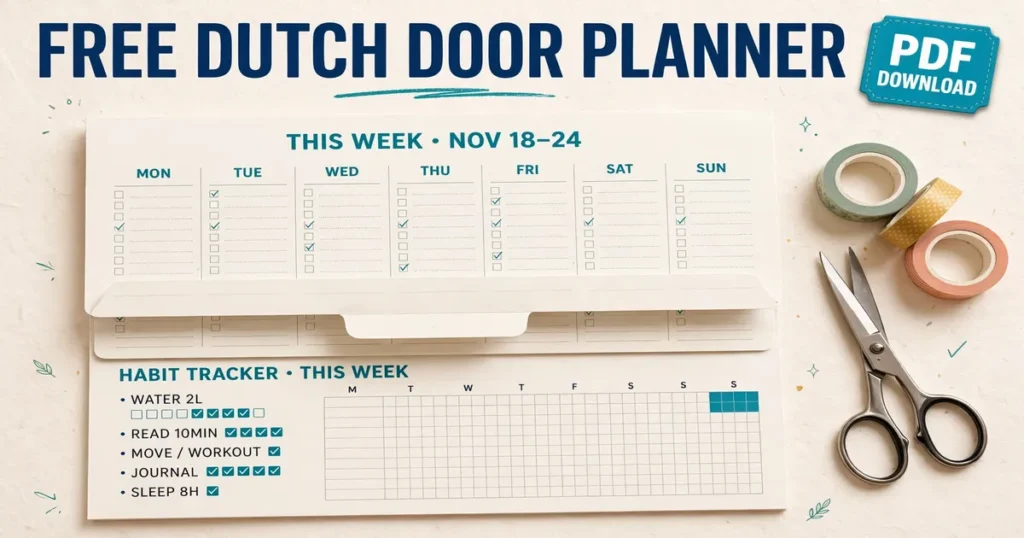
There is a drawer in thousands of homes holding the same sad collection: half-used planners, abandoned by February, their January pages full of hope and their March pages completely blank. If you have ever bought a beautiful planner only to stop using it within weeks, the problem was never your discipline — it was the layout. This free printable Dutch Door planner PDF fixes the exact flaw that kills most planners, and you can download the 8-page starter pack right now, completely free, with no email signup.
A Dutch Door planner uses a brilliantly simple trick from bullet journaling: some pages are cut shorter than others, creating flaps — “Dutch doors” — that let you see two spreads at once. Your weekly overview stays visible all week while you flip through daily pages. Your habit tracker never disappears under a turned page. Everything important stays in front of your eyes, which is why this layout is so loved by planner people, bullet journalists, and ADHD planners who need priorities visible or they vanish from working memory.
This free printable Dutch Door planner starter pack gives you 8 genuinely usable pages: a cover, a setup and cut guide, a weekly overview, two weekly schedule spreads, a habit tracker with a marked Dutch-door cut line, a tasks and priorities page, and a final page pointing to the full 20-page version. Print it at home in minutes, make two simple cuts, and within a day you will understand why planner people get evangelical about this layout.
What Is a Dutch Door Planner?
A Dutch Door planner is any planner or journal using the Dutch door technique: one or more pages are cut shorter — horizontally or vertically — forming a flap that opens to reveal content underneath. The name comes from actual Dutch doors, the split doors whose top half opens independently of the bottom. In a planner, part of the page stays put while the rest moves.
The classic setup is the weekly Dutch door. The left page holds your full-week overview — appointments, goals, habit tracker. The daily pages on the right are cut shorter along a marked line, so as you flip through Monday, Tuesday, Wednesday, the weekly overview never leaves your sight. You plan each day with the big picture anchored beside you — no flipping back and forth, no rewriting weekly goals onto every daily page.
The technique began in the bullet journal community, where journalers cut pages with craft knives to build custom flaps. Printed planner makers caught on and started building Dutch doors into their designs. What was once a fiddly DIY project is now print, cut along a dashed line, and use in under ten minutes — exactly what the free starter pack below is designed for.
Why Planner Lovers Swear by the Dutch Door Layout
The Dutch door solves real, specific frustrations that standard planners create:
- Your week stays visible all week. In a normal planner, turning to Wednesday erases Monday’s context. With a Dutch door, the weekly overview is a permanent resident — always there, never buried.
- Habit trackers actually get used. Trackers fail because they live on pages you stop visiting. A Dutch-door habit tracker sits in the visible flap zone, so you see it daily without hunting for it.
- Less rewriting, less clutter. Weekly goals and running lists live once in the visible area instead of being copied onto every daily page. Your dailies stay clean and focused.
- It works with your brain. Productivity coaches talk about “working memory” — what you can hold in mind while you work. A Dutch door keeps priorities literally before your eyes, the closest paper gets to extending it.
- It is fun to use. There is something satisfying about flipping a little paper door — and planners you enjoy touching are planners you keep using.
- It adapts to your life. Use the visible flap for a grocery list one week, a deadline tracker the next, a gratitude log the week after. The layout is a framework, not a cage.
The best planner is not the prettiest or most expensive one — it is the one whose layout keeps your priorities visible on the days you need them most.
What’s Inside the Free 8-Page Starter Pack
Every page of this free printable Dutch Door planner PDF was designed to be genuinely usable, not a watered-down teaser:
Page 1 — Cover Page
A clean, minimal cover with space for your name and date range. It gives your printed booklet a finished feel and makes multiple packs easy to tell apart.
Page 2 — Setup & Cut Guide
The page that makes everything foolproof: what a Dutch door is, a clear cut diagram, and plain-language assembly steps. Even if you have never modified a planner page, this gets you from printed stack to working Dutch door in minutes.
Page 3 — Weekly Overview
The anchor of the system. Seven day columns for appointments and events, a priorities box for your top three weekly goals, and a notes strip. After cutting, this is the page that never leaves your sight.
Pages 4–5 — Weekly Schedule (Mon–Wed / Thu–Sun)
Two daily spreads with timed blocks from morning to evening plus a to-do column per day. These are the pages you cut along the dashed line — afterward they flip freely while the weekly overview stays put. Time-block each morning in under five minutes.
Page 6 — Habit Tracker with Dutch-Door Flap
A tracker grid for up to eight habits across the week, with its own marked cut line so it lives in the visible flap zone. Check off habits daily without flipping to find the tracker — this one design choice turns “I should track habits” into actually doing it.
Page 7 — Tasks & Priorities
A brain-dump-friendly capture area for everything on your mind, plus a “top 3 today” box forcing the most important morning decision: what actually matters today.
Page 8 — Keep Planning
Points you to the full 20-page ADHD Dutch Door Planner — monthly spreads, budget pages, meal planning, ADHD-specific tools — for when the starter pack wins you over.
How to Print, Cut & Assemble (5 Steps)
From download to working planner in about ten minutes:
- Step 1 — Print at actual size. Print on US Letter paper (8.5 × 11 in). Choose “Actual size” or “100%” — not “Fit to page” — so cut lines land exactly right. Black-and-white is perfect; the design is clean line work for any home printer.
- Step 2 — Cut along the dashed lines. With scissors or a craft knife and ruler, cut the “CUT HERE” lines on the schedule pages and habit tracker. A clean straight cut makes the flap flip smoothly. The setup guide shows exactly where to cut.
- Step 3 — Fold or remove. Fold the cut strip back for a true hinged Dutch door, or remove it entirely for a clean window to the page beneath. Try folding first — it is reversible.
- Step 4 — Bind your pack. Stack the 8 pages and staple the edge, clip with a binder clip, punch for a disc-bound or ring system, or slip into a slim folder. Disc-bound and ring systems are ideal because you can add fresh weekly pages later.
- Step 5 — Set up your first week. Fill the weekly overview with appointments and top three priorities, date the first schedule page, and list habits on the tracker. Flip a daily page and watch the overview stay exactly where it belongs.
How to Use Your Dutch Door Planner Every Day
A planner works when using it becomes a small, pleasant ritual. This daily rhythm takes under ten minutes and makes the layout earn its keep:
- Morning (3 minutes): Open today’s schedule page — the weekly overview is already visible beside it. Time-block your day, pick your top three priorities, and glance at the habit tracker flap.
- Midday (1 minute): When plans change, adjust only the daily page. The weekly overview needs no rewriting — still there, still correct, still visible.
- Evening (3 minutes): Check off habits, cross out finished tasks, jot tomorrow’s must-dos on the next daily page. Then ask: is tomorrow’s plan still realistic?
- Weekly reset (10 minutes): Review the finished week, celebrate completed habits, carry forward the unfinished, and set up a fresh overview. Print and cut new pages if needed.
The golden rule: the weekly overview is for the big picture, daily pages are for execution. Never let daily noise invade the overview. The Dutch door enforces this separation physically — that is the whole point.
5 Dutch Door Ideas to Try Next
After a week with the starter pack, you will see Dutch door possibilities everywhere:
- 1. Monthly overview flap. Full-month calendar on the left, weekly pages cut shorter on the right. Month-at-a-glance permanence with weekly detail on demand — ideal for deadlines, birthdays, and bills.
- 2. Habit tracker window. Dedicate the visible flap entirely to habits: exercise, water, reading, meditation. The hardest-working square inch of your planner.
- 3. Meal plan + grocery list. Weekly meal plan on the visible left page, daily pages cut to reveal it. Fold or tear off the grocery list for the store — one of the community’s most-loved uses.
- 4. Project dashboard. Running a move, renovation, or launch? Keep the timeline and key contacts permanently visible while daily task pages flip beneath. Your project never gets buried under daily trivia.
- 5. ADHD brain-dump flap. A running capture list in the always-visible zone. ADHD brains generate reminders constantly and lose them just as fast; a visible brain dump means “I need to remember this” survives until you can act. Pair it with a daily top-three box so capture turns into action.
Planning Tips for ADHD Brains
Standard planners fail ADHD brains for one specific reason: out of sight, out of mind. A to-do list on page 47 might as well not exist. The Dutch door layout is almost suspiciously well-matched to ADHD needs, because its entire philosophy is keep the important stuff visible:
- Externalize everything. Your brain is for having ideas, not storing them. Dump every task and reminder onto the tasks page the moment it appears — the visible flap keeps your capture list one glance away.
- Shrink the day. Do not plan sixteen tasks. Pick exactly three priorities and time-block them first; everything else is bonus. Three priorities survive the week; sixteen collapse by Tuesday.
- Make starting stupidly easy. Write the literal first physical step, not the project name. Not “plan trip” but “open laptop and search flights.”
- Build in dopamine. Checking off a habit square gives a small reward hit. The visible tracker turns this into a winnable daily game — exactly the feedback loop ADHD brains need.
- Forgive and reset fast. Missed a day? Do not “catch up” — that way lies planner abandonment. Just start today’s page fresh; nothing is ruined.
If this resonates, the starter pack is the on-ramp to something bigger: the full ADHD Dutch Door Planner on Etsy expands the system to 20 pages with monthly spreads, a dedicated brain dump section, time-blindness planning tools, and task chunking worksheets — this article’s philosophy, built out for a full planning life.
More Free Printables You’ll Love
- Teachers swear by our free printable maze worksheets for teachers — 20 no-prep classroom mazes with answer keys.
- Need a proper brain break? Try the free printable music word search for teens and adults — a genuinely relaxing screen-free reset.
- Planning family time too? The free printable Halloween puzzle book for kids keeps little hands busy while you plan.
- For even more printable fun, browse our puzzle shop — free and premium printable books for every age.
Frequently Asked Questions
Is this Dutch Door planner really free?
Yes — the 8-page starter pack is completely free. Download the PDF instantly with no email signup and no payment. Print it as many times as you like for personal use.
What exactly is a Dutch door in a planner?
A Dutch door is a planner page cut shorter along a marked line, creating a flap — like the split top-and-bottom of an actual Dutch door. The flap lets you see two spreads at once, so your weekly overview or habit tracker stays visible while you flip daily pages.
Do I need special supplies to make the Dutch door cut?
No. You need a printer, US Letter paper, and scissors. A craft knife and ruler give a cleaner cut, but scissors work fine. The starter pack includes a setup guide with a diagram showing exactly where to cut.
What paper size does the PDF use?
US Letter (8.5 x 11 inches). Print at 100% or Actual size — not Fit to page — so the cut lines land in exactly the right place.
Can I use this planner if I have ADHD?
Absolutely — the layout suits ADHD planning challenges well. Because the weekly overview, habit tracker, and task list stay visible instead of getting buried on turned pages, it directly addresses the out-of-sight-out-of-mind problem. A full 20-page ADHD Dutch Door Planner with brain dump pages and time-blindness tools is also available.
What is the difference between the free starter pack and the full planner?
The free starter pack is 8 pages: cover, setup guide, weekly overview, two weekly schedule spreads, habit tracker with cut guide, tasks page, and an info page. The full 20-page planner adds monthly spreads, budget pages, meal planning, goal planners, and ADHD-specific tools like task chunking worksheets.
Get Your Free Dutch Door Planner Starter Pack
You are ten minutes away from a planner layout that finally makes sense: print the 8 pages, make two simple cuts along the dashed lines, bind your pack, and start planning with your week, habits, and priorities all visible at once. No email signup, no payment, no catch — just a genuinely useful free printable Dutch Door planner PDF for real life, real ADHD brains, and real busy weeks. Click the big download button below and set up your first Dutch door today.