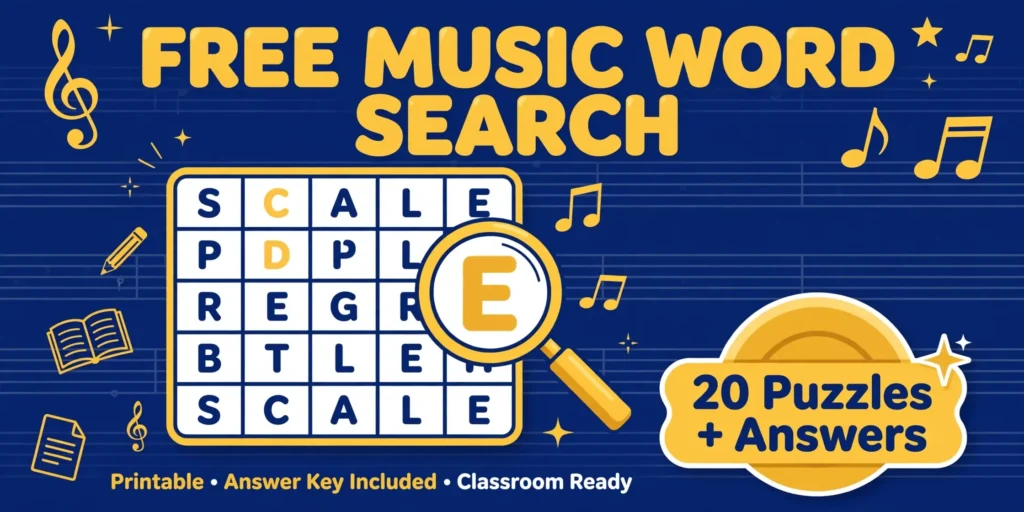
If you teach music, you already know the challenge: keeping a room full of students quietly engaged while still learning something real. This free music word search book was made for exactly that moment. It packs 20 printable music word search puzzles — covering instruments, rhythm terms, musical genres, and classroom vocabulary — into one free PDF, with a complete answer key so you can check work in seconds. It is a genuine no-prep resource: print it, hand it out, and you have an instant bell ringer, sub-plan activity, early-finisher task, or calm-down exercise that reinforces music vocabulary instead of just killing time.
Whether you are an elementary music teacher looking for morning work, a band or choir director who needs a quiet seat-work option, or a classroom teacher planning a music-themed week, this book fits. Every puzzle is classroom-tested in concept: clear grids, bold easy-to-find words, age-appropriate vocabulary, and zero prep on your end.
Why Music Teachers Use Word Searches in Class
Music class is often the liveliest period of the school day — and that energy is wonderful, until you need a calm, focused activity. Word searches give students a structured, quiet task that still connects to what you are teaching. When students hunt for words like TEMPO, RHYTHM, HARMONY, and CHORUS, they are seeing and spelling the vocabulary you use in every lesson.
Here is why so many music educators keep word searches in their back pocket:
- Reinforces music vocabulary. Terms like melody, rhythm, tempo, and harmony stop being abstract once students have searched for them, circled them, and written them down.
- Perfect for transitions. Those ten minutes between rehearsal setup and class start? A word search turns potential chaos into calm, productive seat work.
- Truly no prep. There is nothing to grade in advance and nothing to set up — the answer key is included, so checking takes seconds.
- Differentiated by nature. Fast finishers move on to the next puzzle while students who need more time keep working at their own pace.
- Sub-plan gold. Any substitute can run this lesson. Leave the PDF printed with the answer key sealed in an envelope, and your plans are done.
“The best classroom activities are the ones that teach while they look like play. Word searches sneak spelling, vocabulary, and focus practice into something students genuinely enjoy.” — a veteran elementary music teacher
What’s Inside This Free Music Word Search Book
This is not a single one-page worksheet — it is a complete 20-puzzle book built around the vocabulary music teachers actually use. The puzzles grow gently in challenge as the book goes on, so the first pages suit younger students while the later pages give older students something to chew on.
The four vocabulary areas
- Musical instruments: GUITAR, PIANO, DRUMS, VIOLIN, TRUMPET, FLUTE, SAXOPHONE, CLARINET, CELLO, HARMONICA and more. Ideal for instrument-unit introductions and orchestra family lessons.
- Rhythm and musical terms: RHYTHM, TEMPO, MELODY, HARMONY, BEAT, METER, DYNAMICS, ADAGIO, PRESTO, STACCATO. These are the building blocks of music theory, introduced without a single worksheet that feels like a test.
- Music genres: JAZZ, ROCK, BLUES, CLASSICAL, POP, COUNTRY, OPERA, GOSPEL, REGGAE. A great launchpad for genre-listening units.
- Classroom and performance words: SONG, CHORUS, VERSE, CONCERT, STAGE, ENCORE, LYRICS, BAND, SINGER, ALBUM. Perfect for choir, band, and general music classes.
Every puzzle in the book uses a clean, high-contrast grid with bold, centered word lists — easy on young eyes and photocopier-friendly. And the answer key at the back shows every solution, four puzzles per page, so you can check a whole class in minutes.
How to Use This Book in Your Classroom
One free book, many lesson moments. Here are the ways teachers actually use these puzzles:
Bell ringers and warm-ups
Put one puzzle on each desk as students walk in. It settles the room instantly and gives latecomers time to arrive without missing instruction. Many teachers pair the puzzle with a listening task: “Find the word RHYTHM, then clap the rhythm you hear in this piece.”
Sub plans
This is the most-requested use. Print a stack, leave the answer key with your emergency sub folder, and you are covered. Any substitute can distribute and collect these — no music background required. Write the word list on the board as an extra scaffold if you like.
Early finishers
Students who finish written work early often cause the most disruption simply because they are bored. A word search book at the “finished work” station keeps them engaged and learning instead of chatting.
Test-day or rehearsal downtime
Between concert rehearsals, during standardized testing weeks when music is shortened to a quiet activity, or on indoor recess days — word searches fill these gaps with something calm and educational.
Homework and take-home practice
Send a puzzle home as family-friendly practice. Parents appreciate activities that are screen-free and genuinely educational, and students enjoy them because they don’t feel like homework.
Music Vocabulary Your Students Will Practice
The words hidden in these puzzles were chosen to match the vocabulary of elementary and middle school music curricula. A quick look at what your students will be absorbing:
- Instrument families: strings, brass, woodwinds, and percussion appear across the puzzles, helping students connect the word to the sound.
- Rhythm and notation terms: beat, meter, tempo, rhythm, and dynamics — the exact words students need to describe what they hear and play.
- Form and song structure: chorus, verse, song, encore — useful vocabulary for choir students and song analysis.
- Genres and styles: jazz, rock, classical, opera, gospel — the starting point for respectful, curious listening across cultures and eras.
Teachers of other subjects have told us these work beautifully as themed activities too: our Halloween word search and Thanksgiving word search follow the same classroom-friendly format, and the Christmas word search is a favorite for December calm-down time.
Make It a Full Music Lesson: Pairing Puzzles with Activities
A word search works brilliantly as a standalone activity, but it becomes a full lesson when you pair it with something musical. Here are three ready-made combinations teachers use with this book:
1. Instrument discovery lesson
Start with the instrument puzzle (pages near the front of the book). As students finish, have them sort the found words into instrument families — strings, brass, woodwinds, percussion. Then play a short audio clip of each family and let students identify what they hear. The puzzle primes the vocabulary; the listening cements it. For upper grades, add a writing task: choose one instrument from the puzzle and write three facts about it.
2. Genre tour week
The genre puzzles are a natural gateway to a week-long listening tour. Assign one puzzle per day — jazz on Monday, rock on Tuesday, classical on Wednesday — and play a two-minute excerpt of that genre each morning. Students listen first, then search the words. By Friday they have learned five genres, the vocabulary to describe them, and they barely noticed they were studying.
3. Rhythm and beat workshop
Use the rhythm-terms puzzle before a hands-on beat activity. Students find TEMPO, BEAT, METER, and RHYTHM, then you teach each term with body percussion: clap the beat, stamp the meter, whisper the rhythm. Because students have just handled these words in the puzzle, the concepts land faster. This sequence works especially well with grades 3–5, where the vocabulary-to-movement connection is strongest.
Each of these combinations takes a single puzzle page and stretches it into a complete 20–30 minute lesson — exactly what a busy music teacher needs during packed rehearsal weeks or concert season.
How to Download and Print the Book
Getting your copy takes under a minute:
- Scroll to the download button at the bottom of this post and click it.
- The PDF opens in your browser — save it to your computer, Google Drive, or a USB stick.
- Print on standard US Letter paper (A4 works fine too). Print in black and white to save ink — the grids are designed for it.
- Print the answer key pages separately and keep them for yourself.
The PDF is a single file, so you can also upload it straight to Google Classroom, Seesaw, or your school’s LMS for digital classrooms. Students can print at home or view it on a tablet — the grids are large and readable on screens as well.
Tips for Getting the Most from These Puzzles
A word search is simple, but a few teacher tricks make it a genuine learning tool:
- Add a vocabulary task. After students find a word, ask them to write a one-sentence definition or draw a quick picture of it. Now it’s a two-layer activity.
- Race the metronome. Set a metronome to a steady beat and challenge students to find as many words as they can in 60 seconds — then slow the beat and review.
- Pair with listening. Play a short piece while students work, then ask: “Which genre words from the puzzle fit the music you just heard?”
- Differentiate easily. Younger students can work in pairs and search only for short words; older students can do the full puzzle against the clock.
- Use the words as spelling practice. Pick five puzzle words for the week’s spelling list — students will already recognize them.
- Celebrate finishers. A simple “puzzle completed” stamp or sticker turns completion into a small win, especially for reluctant learners.
Is this music word search book really free?
Yes — completely free. The PDF includes 20 printable music word search puzzles plus a full answer key, with no signup, no email required, and no watermark.
What grade levels is this book good for?
The book is best for grades 2–8. The first puzzles use familiar words like PIANO and SONG for younger students, while later puzzles include terms like HARMONY and STACCATO for older students. Teachers can assign pages by difficulty.
Can I use these puzzles in my sub plans?
Absolutely — this is one of the most popular uses. Print a stack of puzzles and leave the answer key pages with your sub folder. Any substitute can distribute and collect them without any music background.
Is an answer key included?
Yes. The back of the book contains every solution, four puzzles per page, so you can check a whole class quickly or let students self-check in centers.
Can I share this with other teachers or post it on Google Classroom?
Yes. You may print it for your students, share it with colleagues, and upload it to Google Classroom, Seesaw, or your school LMS for classroom use. Please link back to this page rather than re-uploading the file to public file-sharing sites.
Want more puzzles? Browse our puzzle book shop — it adds fresh printable books every day, and the Word Search shelf is a favorite with classroom teachers who want a bigger library for their centers.
Download Your Free Music Word Search Book
This free 20-puzzle music word search book is ready to print — bell ringers, sub plans, early finishers, and quiet classroom moments all covered, with the answer key included. Click the big download button below